
- Trails are open 24/7 at no charge. Enjoy a Winnie-the-Pooh themed TRAIL TALES Storybook Walk.
What’s Happening: Skeletons Everywhere!
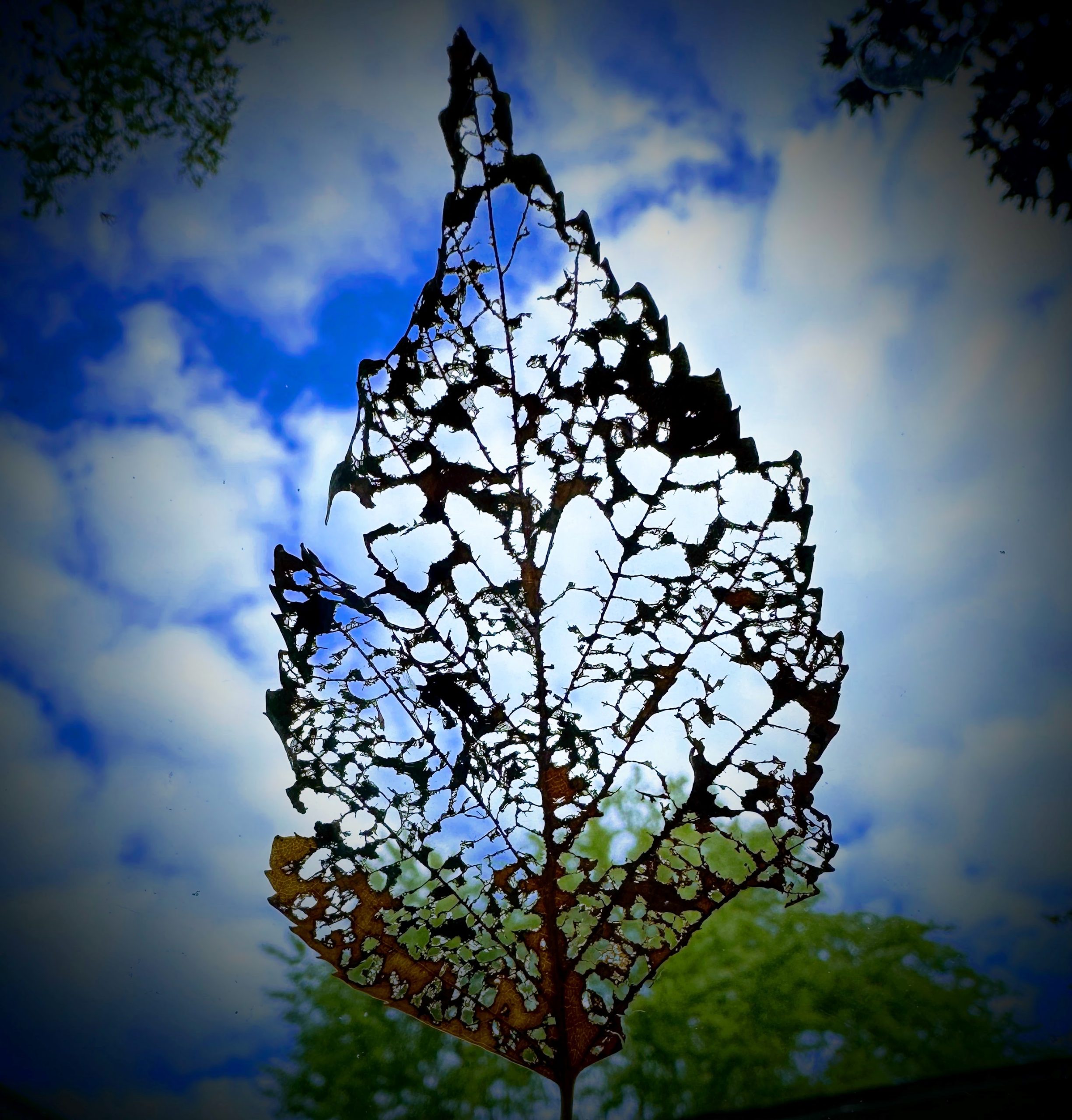
Halloween is coming and we at Crossroads at Big Creek are noticing skeletons everywhere! But we aren’t talking about holiday decorations. This time of year, we start noticing leaf skeletons, tree skeletons, bat skeletons and, thanks to our resident coyotes, random skulls and bones scattered through our preserve.
As we pass the peak of color in the trees, our Wandering Wednesday hiking group will probably be looking at fallen leaves–some intact, but some looking like fancy intricate lace. The caterpillars of several moth species are classified as “skeletonizers” because, at different stages of development, these caterpillars feed on the juicy green tissue of the leaves. They do not eat the veins. Consequently, we find perfect skeletons of the leaves still clinging to trees or blanketing the forest floor.
Then on Wednesday afternoon, participants of the Environmental Exploration activity, which is geared to elementary students but open to learners of all ages, will observe “Leaves in the Creek,” or at least the skeletal remains of them.
In autumn, every leaf that drifts into the water acts as an infusion of nutrients into the complex stream ecosystem. As soon as a leaf hits the water, food is leached from the tissues and quickly is colonized by fungi and bacteria which, in turn, provide carbohydrates and proteins for aquatic insects.
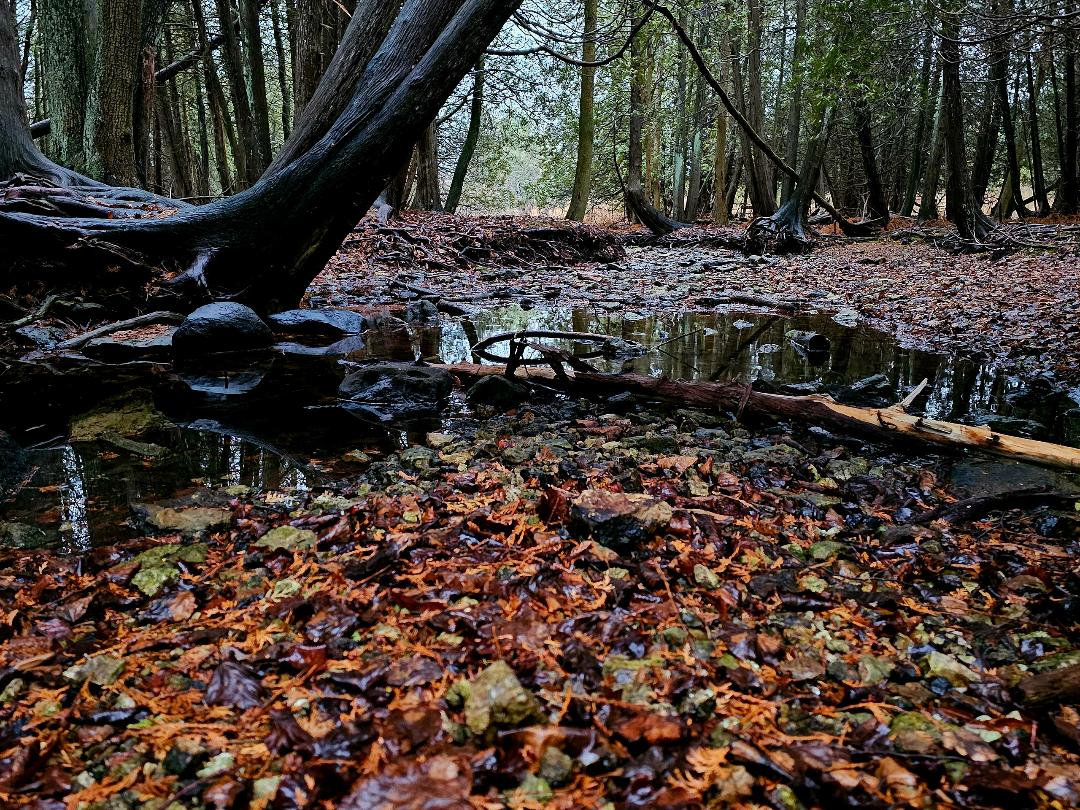
But then, the “shredders”… the leaf-eating aquatic insects such as caddisfly and crane fly larvae and herbaceous stoneflies eat the remaining tissue. The energy from last summer’s sunshine eventually passes through the food web to fish and other aquatic creatures, simply because in fall, leaves fall.
Science Saturday (our weekend family program) will look at Tree Skeletons and will do a bit of forest forensics by examining the leafless branches of deciduous trees.
On the day before Halloween, the Environmental Exploration lesson will be on Bats! Even though we don’t have live bats to observe, we can examine the skeletons of these mammals. The inside bend of a bat wing is the elbow. The hook at the top of the wing is the thumb.
The other “fingers” function as bracing for the wing. The finger bones are sandwiched between two layers of skin. The skin also is attached to the hind legs at the ankles and enclose a very short tail.
With this skeleton (which essentially is the same as that of the of a human–just longer fingers and shorter legs) bats can fly. And their flying ability is remarkable.
While bats snap up insects with their mouths, they can also use their hand/wings or the membranes around their tails which work rather like a baseball glove.
The world has many kinds of bats. Understand that bats in Wisconsin do not suck blood. They do not pollinate flowers. They do not get caught in people’s hair.
Rather, according to the DNR website, “Bats in Wisconsin are insectivorous and are major predators of night-flying insects including agricultural and forestry pests. “A single bat can consume up to 1,000 mosquito-sized insects in an hour and a pregnant female can consume her weight in insects every night. It has been estimated bats save farmers in North America over $22 billion every year in [chemical free] pest control services.”
So those are the bones of the Crossroads activities this week, but the Door Peninsula Astronomical Society will be sponsoring the “School’s Out” program at 2:30 on Friday, October 25. Open to all ages, but geared
middle and high school students, the exercise called “Are We Alone in the Universe?” is a good introduction to the DPAS Citizen Science Exoplanet research. Know (and share with promising young people) that the astronomy society is hoping to mentor Door County pre-college students in this exciting research opportunity next summer.
Finally, our Monday afternoon adult program this week is a screening of the Wisconsin Public Television documentary Wisconsin Water from the Air.
– by Coggin Heeringa, Interpretive Naturalist
For more information, please check out our Crossroads calendar or stop by the Collins Learning Center and pick up a printed calendar. Our trails are open all day every day, free of charge, thanks to the generosity of donors like you!
Crossroads at Big Creek Learning Center and Nature Preserve is located at 2041 Michigan Street, Sturgeon Bay. Crossroads is a 501(c)3 organization committed to offering education, conducting research and land restoration, and providing outdoor experiences to inspire environmental stewardship in learners of all ages and from all backgrounds. We welcome your support.
Upcoming Activities
Monday, October 21
1:30 – 3 p.m. The Bombus Among Us – Bumble Bee Basics
In partnership with the Wild Ones – Door Peninsula Chapter, watch this pre-recorded seminar by Heather Holm.
“Bumble bees (Bombus) are by far our most charismatic and recognizable native bees. In order to help our bumble bees thrive, we must understand their life cycle and nutritional needs. Heather will illustrate the bumble bee life cycle through the growing season; the importance of selecting the right native (woody and herbaceous) plants to meet the nutritional needs of the queens, workers, and males; their habitat; the impacts on populations from climate change; and common upper Midwestern and eastern bumble bee species. She will also feature species in decline including the federally endangered rusty patched bumble bee.”
Meet at the Collins Learning Center.
Tuesday, October 22
6:30 – 7:30 pm Menominee Agricultural History
We will learn how Menominee agriculture has been rediscovered in the forests of our region through the observations of forester and knowledge keeper Jeff Grignon (Paemapameh) and through years of effort by the Menominee Historic Preservation Department. Then, we will explore what archeologists, anthropologists, and agronomists have to tell us about this important part of the Menominee economy over the centuries.
Speakers: Jacob Grignon (Cultural Resource Protection Officer, Menominee Historic Preservation) and Frank Kutka (Sustainable Agriculture Faculty, College of Menominee Nation)
Open to the public. Sponsored by Wild Ones – Door Peninsula Chapter. Part of Wisconsin Science Festival.
Wednesday, October 23
1:30 – 2:30 pm Wandering Wednesdays – Naturalist Led Hike
Join a naturalist-led hike. Easy walking. Meet at the Collins Learning Center. Registration not required. Open to the public and free thanks to our donors.
3:00 – 4:30 p.m. Enviornmental Exploration – Leaves in the Creek
This program is intended for elementary school students but is open to all ages exploring leaves in the creek. (Dress for the weather.) Meet at the Collins Learning Center. Registration not required. Open to the public and free thanks to the generosity of donors like you!
Friday, October 25
2:30 – 3:30 pm School’s Out Excursion!
In collaboration with the Door Peninsula Astronomical Society, teenage participants will learn if there is life on other planets.
Meet at the Collins Learning Center. Registration not required. Open to the public and free thanks to the generosity of donors like you!
Saturday, October 26
2:00 – 4:00 pm Science Saturday – Tree Skeletons
Join this indoor / outdoor program and learn about tree structure and bark. Dress for the weather. This weekly family program is intended for elementary students, but learners of all ages are welcome.
Meet at the Collins Learning Center. Registration not required. Open to the public and free thanks to the generosity of donors like you!
