
- Trails are open 24/7 at no charge. Enjoy a Winnie-the-Pooh themed TRAIL TALES Storybook Walk.
What’s Happening: Something’s Fishy
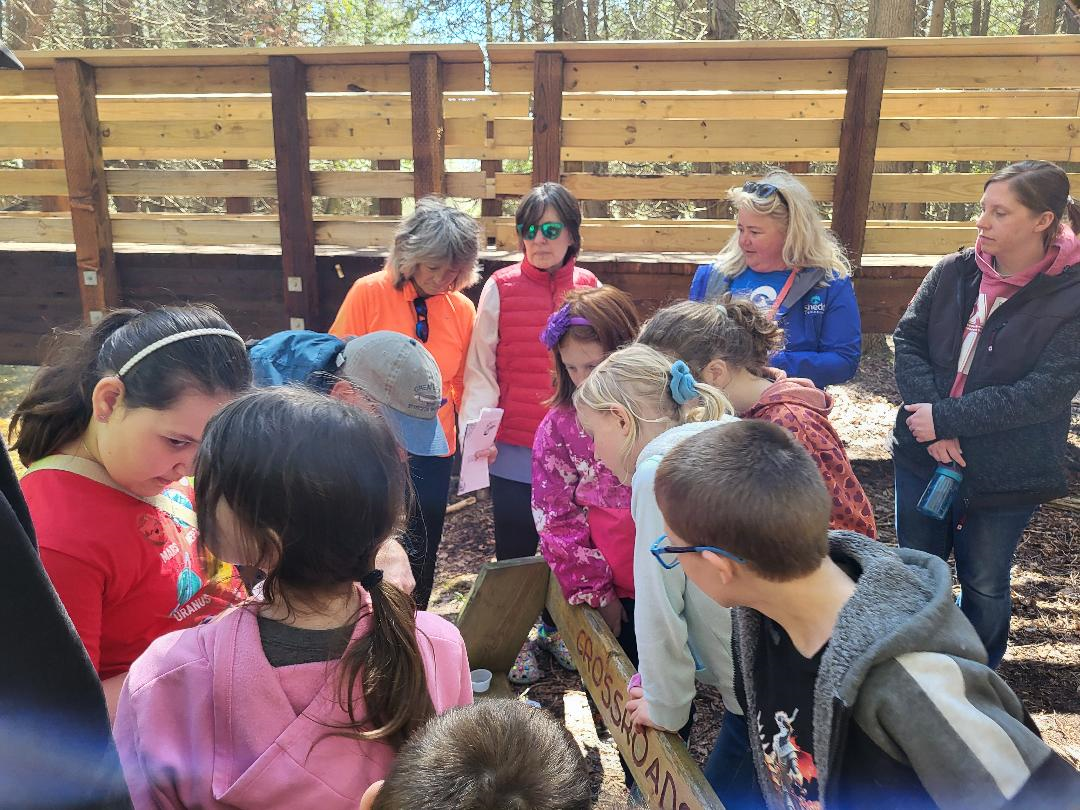
Sturgeon and suckers and pike—OH MY! It’s predictable. This time of year, all of us—staff, researchers, volunteers, and visitors—turn our attention to fish because, around now, fish instinctively migrate into the tributaries of the Great Lakes. And the human migration to Crossroads during this time of year has been happening ever since there was a Big Creek.
We start our fish tales on Thursday, March 27, at 7:00 p.m. with a Fish Tales lecture featuring Jeremy Pyatskowit (Director of the Environmental Services Department – Menominee Indian Tribe of Wisconsin). He will present “Fisheries of the Menominee Nation” and discuss fish management with an emphasis on sturgeon.
Maintaining a cherished Crossroads tradition, our Saturday Science program for learners of all ages will be a Pike Hike. Each spring, these large fish swim into the Cove Estuary and then follow Big Creek, passing under County Highway TT into the warm (comparatively) shallow waters north of the preserve. There, they spawn, and their fry quickly develop before moving back through the preserve, feeding on sucker eggs, fry, and other small creatures—including their own siblings—on their way to the big lake.
We almost always find pike, but it isn’t easy. They are perfectly camouflaged to blend in with the creek bottom.
That’s why our April Fool’s Day after-school program will focus on camouflage—how fish markings “fool the eye.” This program will be offered outdoors if the weather (and fish) cooperate.
And then—The Sucker Run!
Archaeologists and Indigenous historians are convinced that the first people to live—at least seasonally—beside The Cove and Big Creek depended on suckers. European settlers in the mid-1800s certainly did.
In the 1881 publication A Brief History of Door County, Charles Martin shared a letter from a logger who lived through the financial crash of 1857:
“I have known the time when we had to make meals on potatoes and salt. We used to spear suckers in the creek in spring, and then we were living high again. I heard a remark that some men could not get their shirts off, and when asked the reason, they said they had eaten suckers so long that the bones stuck through their skin, and their shirts were fast.”
We are told that at the turn of the last century, people came to the creek to harvest suckers, which they pickled or pressure-cooked, and canned. Locals fondly reminisce about leaving their proms early to spend the rest of the night dipping for suckers and smelt in Big Creek.
Since Crossroads acquired a stretch of the creek, school groups have made annual pilgrimages to witness the sucker run—an event one young lad deemed “better than fireworks!”
Formal sucker research at Crossroads began in 2011 when Evan Childress, from the University of Wisconsin Center for Limnology, installed automated thermometers and water velocity meters near Hanson Bridge. Each day during the test period, Crossroads staff took depth readings and, following a designated protocol, counted the number of longnose and white suckers passing a specified point, documenting the arrival dates of various species and trying to determine the factors that triggered the run.
Those triggering factors intrigued Dr. Karen Murchie, Director of Freshwater Research at Chicago’s Shedd Aquarium. Since 2020, under her direction, Crossroads staff and volunteers (along with volunteers at other Door County tributaries) have participated in a multi-state community science effort studying the migratory patterns of suckers in the Great Lakes region.
According to Dr. Murchie: “Suckers are among the most abundant migratory fishes in the Great Lakes region, serving as a crucial food source for game fish, mammals, and birds. Their spawning activities introduce important nutrients into waterways, supporting the broader aquatic food web. If you love [fish], you can thank a sucker for helping them survive.”
Dr. Murchie employs biotelemetry, blood chemistry analyses, and genetic studies to understand sucker behavior. Based on her research, she believes that suckers exhibit strong site fidelity, returning to the same spawning sites annually.
At Crossroads, we aim to foster public appreciation for these undervalued but essential fish. We invite the community to visit during the run—and perhaps chat with Dr. Murchie. Watch the ticker on our website for the latest “sucker run” status.
– by Coggin Heeringa, Interpretive Naturalist
For more information, please check out our Crossroads calendar or stop by the Collins Learning Center and pick up a printed calendar. Our trails are open all day every day, free of charge, thanks to donors like you!
Crossroads at Big Creek Learning Center and Nature Preserve is located at 2041 Michigan Street, Sturgeon Bay. Crossroads is a 501(c)3 organization committed to inspiring stewardship of the environment through education, research, and outdoor experiences. We welcome your support.
Upcoming Activities
