
- Trails are open 24/7 at no charge. Enjoy a Winnie-the-Pooh themed TRAIL TALES Storybook Walk.
What’s Happening: Wildflowers and Bees
At Crossroads at Big Creek, we strive to inspire environmental stewardship in learners of all ages. That’s why we offer programs for youth camps and families, in addition to lectures and events geared toward adults.
This week, young people from the Boys and Girls Club will explore alongside our staff discovering the creek and playing along our trails. Free family programs open to the public are scheduled for Monday, Tuesday, and Wednesday at 1:00 p.m.
On Thursday, July 17, our focus shifts to adult learners. At 2:00 p.m., we’ll offer an “adults-only” Nature Treks with Terrie, highlighting native summer wildflowers. Pre-registration is required and available through our website.
Wildflowers are more than just beautiful—they’re essential players in the ecosystem. While trees and grasses are often wind-pollinated, and some flowers self-pollinate, most of the wildflowers we enjoy in midsummer rely on insects. And for pollination to succeed, timing is everything.
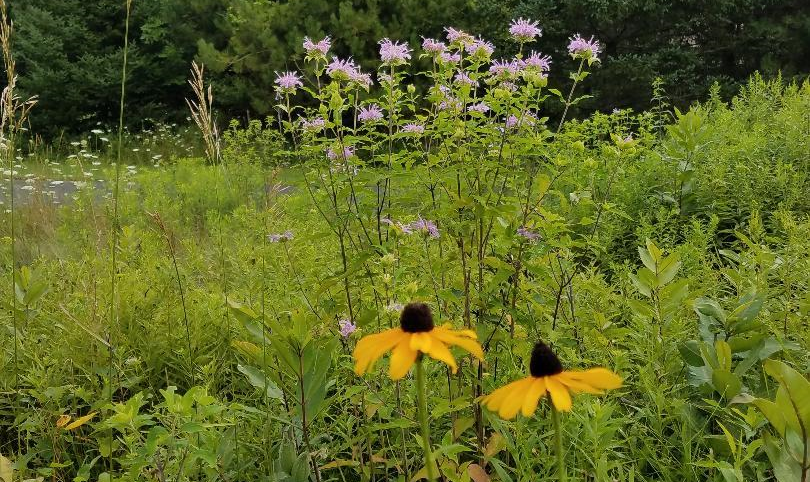
The lives of native wildflowers and their insect pollinators are intricately synchronized to ensure mutual survival. Hikers may notice that many midsummer flowers are yellow or purple—the colors most attractive to native bees.
Wisconsin is home to several hundred species of native bees. Some are generalists, gathering nectar and pollen from many types of flowers. But about a third are specialists, meaning they visit only one or two closely related flower species. Some rare plants are pollinated by a single bee species, which emerges and forages only during the brief window—a mere week or so—in which its partner flower blooms. Even the time of day matters. Many—but not all—wildflowers release a scent at specific times to coincide with their pollinators’ activity. Flowers pollinated by bees usually emit fragrance in the morning, while those white or light-colored flowers relying on moths wait until dusk to give off their scent.
Our beautiful Ohio spiderworts, in contrast, are unscented and their blossoms wilt by noon— (they do not wilt they close up in the afternoon/evening during hot weather as a form of nyctinasty only displaying its beauty when the conditions are best!) but they are bright purple and have lots of pollen, and conveniently (but probably not coincidently) their pollinators—bumble bees, sweat bees, and long-horned bees—forage in the morning. You’ll learn more about these fascinating relationships if you join us for Nature Treks with Terrie.
If it’s been a while since you contributed to Crossroads—or if you’d like to make an additional gift—now is the perfect time. Through July 31, every dollar donated will be matched (up to $10,000) thanks to the generosity of Jim and Donna Janning. Your gift will support stewardship of the Big Creek Watershed and help preserve our natural spaces for generations to come. Click here to donate now.
– by Coggin Heeringa, Interpretive Naturalist
For more information, please check out our Crossroads calendar or stop by the Collins Learning Center and pick up a printed calendar. Our trails are open all day every day, free of charge, thanks to donors like you!
Crossroads at Big Creek Learning Center and Nature Preserve is located at 2041 Michigan Street, Sturgeon Bay. Crossroads is a 501(c)3 organization committed to inspiring stewardship of the environment through education, research, and outdoor experiences. We welcome your support.
Upcoming Activities
