
- Trails are open 24/7 at no charge. Enjoy a Winnie-the-Pooh themed TRAIL TALES Storybook Walk.
What’s Happening: Wetland Restoration
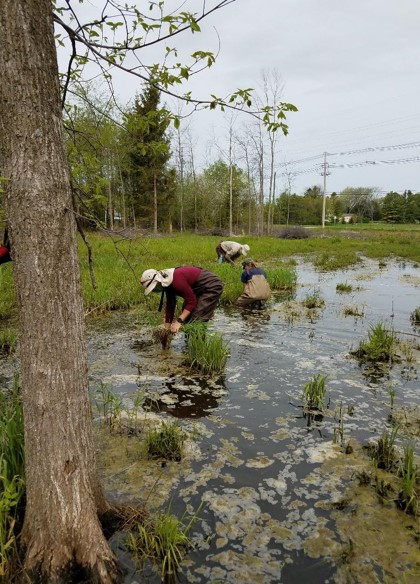
At Crossroads, we call an informal group of volunteers “Habitat Healers.” We invite volunteers of all ages and abilities to join us to help us achieve our restoration goals.
In the north end of the Big Creek preserve, much of which is wetland. And in recent years, this area has undergone significant ecological change. Since European settlement, the land has experienced major human impacts. Forests were cleared, Big Creek was straightened, and wetlands were drained. Yet for many decades, ash trees thrived in the moist soil along the creek.
The first restoration project at Crossroads focused on returning the creek to its original meandering path. Over time, however, invasive plants—particularly reed canary grass and buckthorn—took hold. When the emerald ash borer wiped out the once-shady ash grove, sunlight flooded the area. Coincidentally, the site was literally flooded due to a period of unusually high water.
Suddenly, the landscape transformed into a dynamic wetland community—a mosaic of sedge meadow and alder thicket (shrub carr), rich with sedges and a surprising diversity of wetland flowers, including some that are relatively rare.
Restorationists believe that this change was triggered by the activation of the seed bank, which they define as “a reservoir of viable seeds stored in the soil.” In wetlands, such seed banks often contain seeds from native hydrophytic (water-loving) plants, even if the above-ground vegetation has been altered by past degradation.
Unfortunately, seed banks also harbor invasive species, so for the past four years, we’ve engaged in labor-intensive efforts to reduce undesirable vegetation.
This week, our Habitat Healers will focus on expanding biodiversity by collecting seeds from native wetland plants, with the goal of bolstering seed banks in areas still lacking in diversity. We understand that success depends on hydrology—wetland seeds will only germinate under the right conditions. But by establishing a native seed bank, and with adequate moisture, we hope to enhance the habitat for wetland wildlife.
One of this week’s Journeys with Joan programs is titled “Welcome Back” She will explain that butterflies and pollinators depend on native plants for food and reproduction. Some insects, in fact, are exclusively reliant on specific wetland species, and without them, we would not have our songbirds. On Thursday, Terrie Cooper will lead a guided hike for adults offering an in-depth look at wetland restoration in this region.
Our restoration work aims to improve both the resilience and ecological quality of our land. Just as important, we hope to inspire and educate local landowners and land managers by sharing what we’ve learned through our ongoing projects.
– by Coggin Heeringa, Interpretive Naturalist
For more information, please check out our Crossroads calendar or stop by the Collins Learning Center and pick up a printed calendar. Our trails are open all day every day, free of charge, thanks to donors like you!
Crossroads at Big Creek Learning Center and Nature Preserve is located at 2041 Michigan Street, Sturgeon Bay. Crossroads is a 501(c)3 organization committed to inspiring stewardship of the environment through education, research, and outdoor experiences. We welcome your support.
Upcoming Activities
