
- Trails are open 24/7 at no charge. Enjoy a Winnie-the-Pooh themed TRAIL TALES Storybook Walk.
What’s Happening: Open Land

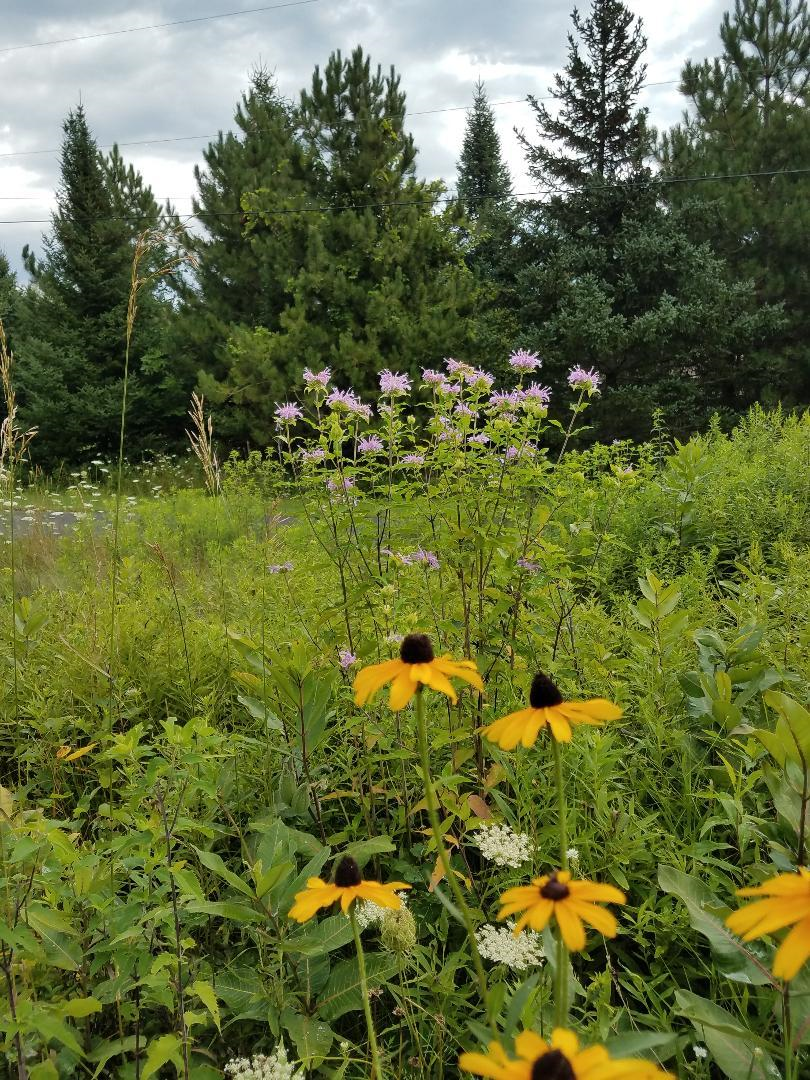
By planting and maintaining an open land, one is contributing to the food web. Green plants capture the energy of the Sun and convert it to food. That energy is passed along when animals eat the leaves, stems and roots of a plant.
But many creatures great and small are carnivores. Not able to eat plants, they can obtain food energy only by eating the creatures that do eat plants. And of the herbivores, caterpillars –immature forms of moths and butterflies—apparently are the most important link in the food chain.
Dr. Douglas Tallamy, entomologist, native plant advocate, and professor and his students have been studying caterpillars and native plants. They conclude that “not all native plants are equal. Some plants have more ecological value than others… Most native plants don’t offer much value in terms of the number of moth and butterfly caterpillars they host.”
Their research shows that 14% of native plant species are larval hosts for 90% of caterpillar species.
Host plants are defined as plants that provide food for butterfly or moth larvae (caterpillars). Adult butterflies/moths lay their eggs on host plants, then the larvae hatch and eat from the plant before undergoing metamorphosis into butterflies.
Monarch butterflies are famous for laying their eggs only on milkweed plants. They are not unique! Almost all butterflies and moths are very, very selective, laying eggs solely on one or several species of plants.
Surprising to most, trees such as oaks, cherries, and willows host the greatest number of moth and butterfly species, but many upland wildflowers are host plants. The greater the diversity of plants, the greater the diversity of moths and butterflies. That said, some native flowers host far more butterfly species than others and it would be wonderful to just list these plants.
But here is the glacier connection: In addition to giving us the Great Lakes, the glaciers left the Door Peninsula with several different and difficult soil types. We have sand and clay and rock and wet areas. Just as certain plants support certain insects, different soil types support different host plants.
To meet restoration goals, a landowner or manager needs to introduce plants that will thrive in the unique conditions of their land and to select plants having the greatest ecological value. The Landowner Series was created to help interested citizens learn how best to manage the land they steward. While we encourage people to attend in person so they can meet and talk with the restoration professionals, we will record the lectures, and they will be posted on our website soon. Visit crossroadsatbigcreek.org/news/videos
Crossroads also offers Summer Nature Programs on Mondays, Tuesdays, and Wednesdays at 10:00 am. All are welcome and reservations are not needed. For more information please check out our Crossroads calendar or stop by the Collins Learning Center and pick up a printed calendar.
Crossroads at Big Creek Learning Center and Nature Preserve is located at 2041 Michigan Street, Sturgeon Bay. Crossroads is a 501(c)3 organization committed to offering education, conducting research and land restoration, and providing outdoor experiences to inspire environmental stewardship in learners of all ages and from all backgrounds. We welcome your support.
Upcoming Activities
Monday, July 29
10:00 – 11:00 am Summer Nature Program – Butterflies
Join our summer naturalist for free family-oriented activity. Butterflies are masters of transformation. Seek our summer butterflies in Crossroads’ gardens, meadows and fields. Nets will be provided. Free and open to the public.
Tuesday, July 30
10:00 – 11:00 am Summer Nature Program – Glaciers
Join our summer naturalist for free family-oriented activity. Ice Age glaciers provided Wisconsin with an amazing gift-our Great Lakes. We will explore how glacial ice has transformed our landscapes.
Wednesday, July 31
10:00 – 11:00 am Summer Nature Programs – Insect Safari
Join one of our naturalists for some free family-oriented activities and nature exploration. Suitable for all ages. Learn the secrets of insects as they transform from egg to adult. Hand lenses and collecting nets provided.
As always, our trails are open all day every day, free of charge. Check the Crossroads website calendar for upcoming events and details.
